Gateway West (GWW) will enable Idaho Power to move energy efficiently and affordably across our system or import it from outside our service area to meet customer needs, especially in the summer. It is a key component of the company’s nonstop work to safely provide reliable, affordable energy when and where our customers need it, and improve the resilience and reliability of the Western energy grid.
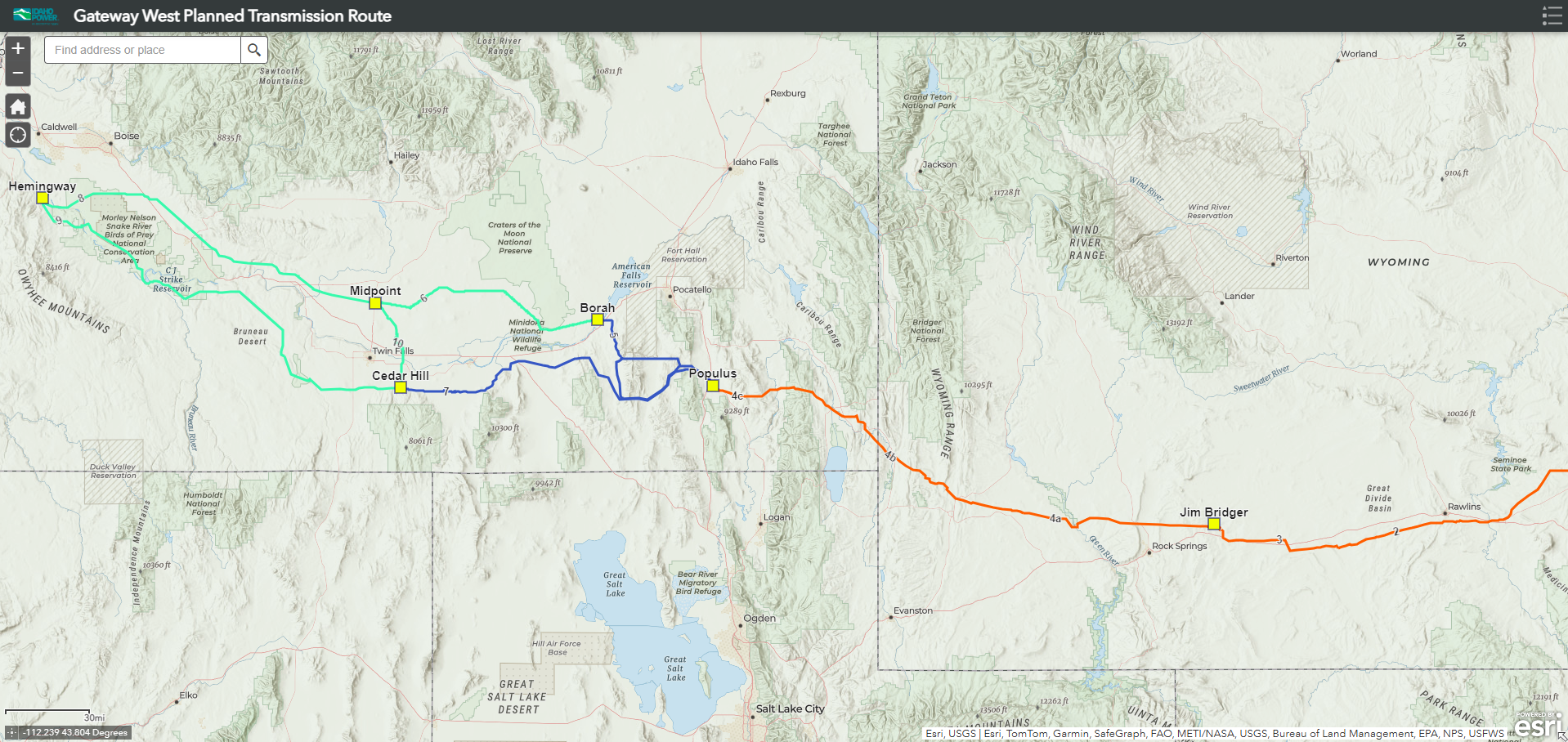
Click on the map above to see an interactive map of Gateway West.
Project Details
Gateway West (GWW) is a transmission line that will stretch from eastern Wyoming near Casper to Idaho Power’s Hemingway Substation in southwest Idaho. GWW will include several segments. Most of the line will be 500-kilovolt (kV). Some segments will be 230-kV. Most of Idaho Power’s investment in GWW involves the segment that runs from the Hemingway Substation to the Midpoint Substation near Jerome, Idaho — two of the most important energy hubs in Idaho Power’s system. This portion of the line is sometimes referred to as Segment E-8.
Project Benefits
GWW will relieve constraints on existing powerlines inside Idaho Power’s service area, helping us deliver energy safely, reliably, and affordably to the homes, farms, and businesses that need it at the exact moment they need it.
Projects like GWW and Boardman to Hemingway contribute to a well-connected grid that allows more efficient sharing and use of energy inside and between regions. This keeps prices down by reducing the total amount of plants, power lines, substations, and other equipment needed to meet customers’ needs.
Project Status
PacifiCorp, GWW’s majority owner, has completed construction of some of the project’s eastern segments. Idaho Power expects to start construction in 2028 on the western portions of the lines that we have an ownership interest in, starting with Segment E-8 between the Hemingway and Midpoint substations.
Common Questions
How will GWW benefit Idaho Power customers?
GWW will increase capacity to move energy between the Hemingway and Midpoint substations so that homes, farms, and businesses across southern Idaho and eastern Oregon to safely and reliably receive the energy they need when they need it.
Why doesn’t Idaho Power just build more local energy resources?
We are. Our approach to reliably serving our growing customer needs is an “all of the above” approach. Idaho Power evaluates all available resources every two years, looking at cost, risk, and reliability to determine the best resource options for our customers.
Idaho Power is already adding natural gas, battery storage, and transmission lines to our system. We’ll continue adding resources in the coming years to ensure our customers can get the energy they need. GWW will provide additional capacity to move energy between the Hemingway and Midpoint substations — two of the most important energy hubs in Idaho Power’s system — so that homes, farms, and businesses can get affordable energy they need when they need it.
Other transmission projects have taken decades to build. Will this be
any different?
GWW is not a new project. It has been under construction for years, starting in Wyoming and moving west. PacifiCorp, Idaho Power’s co-participant in GWW, has begun building GWW in Idaho and has obtained many of the permits for segments of the line that have yet to be built.
Idaho Power expects the western portion of the line that we partly own to start coming online as soon as 2028.
Is this new transmission line just enabling Idaho Power to sell energy
to other states?
No. GWW will help Idaho Power move deliver energy to customers safely, reliably, and affordably by moving it more efficiently inside our service area. It could be used to import energy from outside the region or, if we’re producing more energy than our customers are using, send it elsewhere, but that is not the project’s primary purpose.
How was the GWW route decided?
PacifiCorp, GWW’s majority owner, and Idaho Power have worked for years to find the best route for GWW. This process included working with private landowners, tribes, and local, state, and federal government bodies to minimize the project’s impacts on grazing and other agricultural activities, archaeological resources, protected animals and plants, and other concerns.
How tall will the structures be?
Most of GWW’s structures will be 145-180 feet tall. Some could be taller or shorter due to topography and other variables.
Can farming or grazing still occur under the lines?
Yes. Easements PacifiCorp and Idaho Power obtain for GWW to cross farmland allow the landowners to continuing using their land as long as those uses don’t interfere with the safe operation, maintenance and repairs of the line.
How does this affect fire risk?
Idaho Power puts safety first. Keeping the communities we serve safe from wildfire is part of that commitment. As with all projects Idaho Power owns or operates, the company will build, inspect, maintain, and repair GWW regularly and as needed to keep it operating safely, reliably, and efficiently.
Who approved this project?
Several local, state, and federal agencies have approved permits for GWW.
Contact Information
If you have questions about the Gateway West project, or have information you want to share, contact us at info@gwwe8.com or 208-288-6142.